SSO & corporate identity providers
← back to overview · see also auth-and-tenancy.md · operator setup walkthrough: ../deployment/sso-setup.md
OpenSteward can delegate admin-user authentication to a corporate identity system instead of (or alongside) local username/password accounts. This covers the AdminUser layer only — the DeveloperKey / EndUserCustomer / Connection layers in auth-and-tenancy.md are unchanged.
Four enterprise protocols are supported under one pluggable identity provider abstraction:
| Protocol | Library | Flow |
|---|---|---|
| OIDC / OAuth2 | openid-client |
Auth Code + PKCE, browser redirect |
| SAML 2.0 | @node-saml/node-saml |
SP-initiated redirect, signed assertions |
| LDAP / Active Directory | ldapts |
Search-then-bind on the login form |
| SCIM 2.0 (provisioning) | hand-rolled Fastify + Zod | IdP pushes users/groups |
The linchpin
Section titled “The linchpin”admin-api is the source of truth and issues a JWT { id, username, role }
(apps/admin-api/src/core/routes/auth.ts). Every SSO path converges on
issuing that same JWT, after which all existing RBAC
(requireAuth / requireRole) works unchanged. The admin UI wraps the JWT in
its signed session cookie exactly as it does for local login.
Data model
Section titled “Data model”All SSO state lives in the admin DB via IdentityStore
(apps/admin-api/src/core/db/identity-store.ts), which shares the
AdminStore connection:
identity_providers— one row per IdP (protocol, non-secretconfig_json, AES-256-GCM-encryptedsecret_enc,jit_enabled,default_role, and — sinceidentity_storev2 —default_scope_mode/default_tenant_ids_json).identity_links— external identity (provider_id,external_id) → localusers.id. The JIT lookup key;scim_managedflags SCIM-owned accounts.role_mapping_rules— group/claim → role rules (priority-ordered). A rule grants a built-inrole, or a custom role throughrole_id(v2);rolethen holds that role’s base role.scope_mapping_rules— group/claim → tenant scope rules (v2). Every matching rule applies; their tenants are unioned.scim_tokens— per-provider SCIM bearer tokens (hashed, prefix-indexed).scim_groups— SCIM-pushed group membership feeding role mapping.sso_transactions/saml_replay/saml_request_cache/sso_handoff— short-lived round-trip + replay-protection state.
Secrets are encrypted with the deployment STORE_SECRET and a dedicated salt
(opensteward-sso-v1) via the shared encrypt/decrypt
(packages/shared/src/auth/crypto.ts). The API only ever returns a redacted
view (hasSecret: boolean).
Login flow (OIDC / SAML)
Section titled “Login flow (OIDC / SAML)”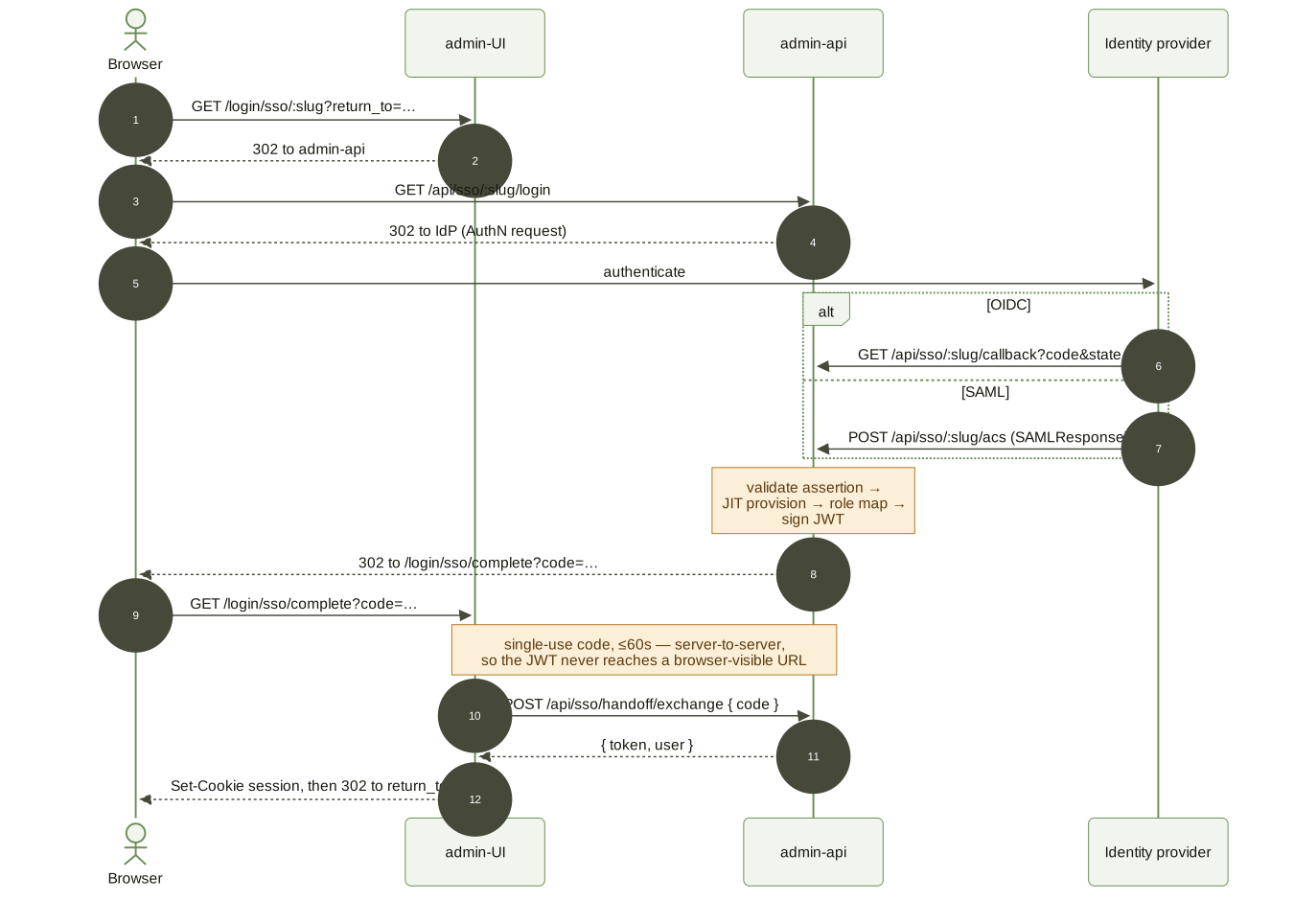
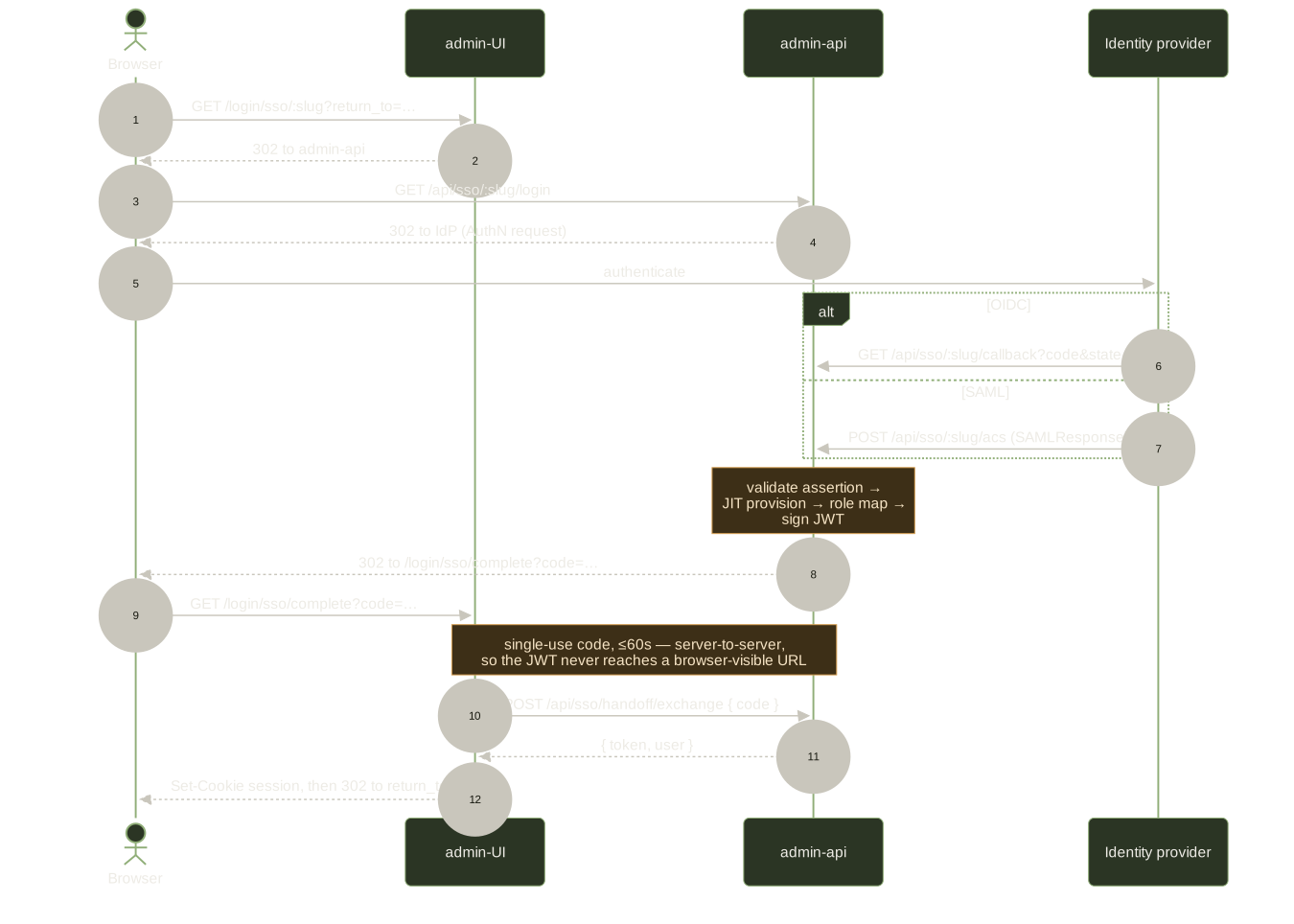
The IdP round-trip terminates in admin-api (it owns the secrets and the JWT
signer); the UI never parses raw assertions. The issued JWT is handed to the UI
through a single-use, ≤60s code so it never appears in a browser-visible
URL. LDAP skips the redirect: the browser posts to the UI’s own
/login/sso/:slug/ldap (rate-limited to 5/min), which calls admin-api’s
/api/sso/:slug/ldap-login server-to-server and receives the JWT directly.
Three public UI routes carry this: GET /login/sso/:slug (redirect to the
initiation endpoint), POST /login/sso/:slug/ldap, and
GET /login/sso/complete (exchanges the handoff code). All three sit ahead of
requireAuth — there is no session yet.
JIT provisioning & role mapping
Section titled “JIT provisioning & role mapping”On every successful SSO/LDAP auth (jit-provisioning.ts):
- Look up the
identity_link; reuse the linked user if present. - Otherwise, if
jit_enabled, create a local user with a random unusable password hash (so it can never log in locally) and link it. - Resolve the role from
role_mapping_rules(ascending priority, first match wins; elsedefault_role) and re-apply on every login so IdP role drift propagates. A rule may name a custom role (roleId); the user then holds it with its base role inusers.role. Every login + role change is audit-logged. - Resolve tenant scope — see Scope mapping.
Scope mapping
Section titled “Scope mapping”Which tenants an SSO user may see (see
permissions-and-roles.md for what a restricted
user can and cannot do). resolveScope() in role-mapping.ts:
- Every matching
scope_mapping_rulesrow contributes its tenants — a union, not first-match, because group membership is additive. A tenant granted*verticals by any rule covers every vertical. - A matching rule whose tenant list is
["*"]grants every tenant (all). - No match → the provider’s default scope:
all(what every provider created before scope rules keeps) orrestrictedto its default tenants (none, when that list is empty — the starting point for every newly created provider).
Admins are always unrestricted: a user whose resolved role is admin never
gets a scope written, so a group mapped to an admin role means every tenant.
Otherwise the result is written to the user’s user_scopes only when the
user’s scope_source is idp. JIT- and SCIM-created users start that way; an admin
who sets a user’s scope by hand in the console flips it to manual, and the
IdP stops overwriting it (it can be handed back with source: "idp" on
PUT /api/users/:id/scope). Rule routes:
GET/POST /api/identity-providers/:id/scope-rules,
DELETE …/scope-rules/:ruleId, and PATCH /api/identity-providers/:id/default-scope
— admin role plus users:manage, and a caller can only grant tenants inside
its own scope.
Profile: email and picture
Section titled “Profile: email and picture”At every SSO sign-in (OIDC, SAML, LDAP) and every SCIM create, replace and
patch, IdpProfileSync (auth/idp/profile-sync.ts) copies what the IdP
asserts onto the console user.
| Source | Picture | |
|---|---|---|
| OIDC | email — the ID token’s claim, else userinfo’s. Ignored when email_verified is false — the boolean, or the string "false" in any case ("False", "FALSE"). A missing email_verified is treated as verified, as is any other value: most IdPs only send the claim when they track it. |
picture (userinfo, else the ID token) |
| SAML | The provider’s emailAttribute (default email), then email, mail, urn:oid:0.9.2342.19200300.100.1.3, the Entra/ADFS claim http://schemas.xmlsoap.org/ws/2005/05/identity/claims/emailaddress, then a NameID in email form. Multi-valued attributes use the first value. |
The provider’s pictureAttribute if set, else the first of picture, photo, photoUrl, photoURL, avatar |
| LDAP | The provider’s emailAttribute (default mail) |
— (directory photos are binary, not URLs) |
| SCIM | emails: the primary entry, else the first |
photos: a photo entry (the primary one first), else a thumbnail, else the first |
SCIM PatchOps are read in the shapes IdPs send: path: "emails" with an
array, Entra ID’s filtered path (emails[type eq "work"].value with a string),
and a path-less value object holding either. remove of emails or photos
drops only IdP-owned data. A replace (PUT) that leaves emails or photos
out changes nothing, rather than clearing them.
Precedence — what a person set in the console wins:
- Email.
users.email_source = 'manual'(typed by an admin at creation or on the user page) is never overwritten. Otherwise the IdP’s address is stored asidpand refreshed whenever it changes. The IdP’s write is conditional in SQL (… WHERE email_source IS NULL OR email_source = 'idp'), so an admin’s edit that lands while a sign-in is being processed is never overwritten or flipped back toidp; a SCIMremoveclears only anidpaddress the same way. Invalid addresses are ignored; so is an IdP that sends none. An admin clearing the email hands it back to the IdP. - Picture.
user_avatars.source = 'upload'is never replaced. An IdP picture is refetched only when the URL changes: the row stores the sha256 of the URL it came from, so an unchanged sign-in costs one metadata read. The IdP write is a single conditional upsert (… DO UPDATE … WHERE source = 'idp'), so an upload that lands while a fetch is in flight wins. An IdP that stops sending a picture leaves the last one in place.
Timing. The email is written before the sign-in completes (a local
write). The picture is fetched fire-and-forget: the sign-in redirect (or
SCIM response) does not wait for a third-party host, and the picture shows on
the next page load. Concurrent sign-ins of one user share one fetch, and at
most 4 fetches run at once in the whole process: past that a fetch is
dropped (logged at debug) and the user’s next sign-in or SCIM update tries
again. A user deprovisioned while their picture was in flight never keeps an
avatar row. Nothing
in the sync can fail a sign-in: every error is caught and logged at info
with the user id, the URL’s host and a coarse reason — never the URL
(query strings carry signatures) and never the email.
Fetching an IdP picture safely
Section titled “Fetching an IdP picture safely”The picture URL is IdP- (often user-) controlled, and admin-api fetching it is
an SSRF sink. fetchIdpAvatar (auth/idp/avatar-fetch.ts) applies, in order:
https:only, the default port only, no credentials in the URL.- DNS through c-ares, not
dns.lookup: A and AAAA are asked in parallel with one try and a timeout of the remaining budget, and outstanding queries are cancelled at the deadline. Once one family answers, the other gets a 300 ms grace and is then dropped — a nameserver that silently discards AAAA must not turn every fetch into a timeout. Whatever arrives in time is vetted like the rest. (dns.lookupruns on the libuv threadpool, which bcrypt shares, and cannot be cancelled — a nameserver that never answers would stall sign-ins.) c-ares does not read/etc/hosts. - Every resolved A/AAAA record must be public. IPv4: private (10/8,
172.16/12, 192.168/16), loopback, link-local (incl. 169.254.169.254),
carrier-grade NAT, unspecified, multicast (224/4), reserved (240/4,
broadcast), benchmarking, documentation and the 6to4 relay 192.88.99.0/24
are refused. IPv6 is an allow-list: global unicast
2000::/3only — which already excludes::1,fc00::/7, link-local, multicastff00::/8, IPv4-mapped::ffff:0:0/96, SIIT and local-use NAT6464:ff9b:1::/48— with one exception: DNS64’s64:ff9b::/96(what an IPv6-only network synthesises for IPv4-only hosts) is decoded and allowed exactly when the IPv4 it carries passes the IPv4 rules. Within 2000::/3,2001::/23(including Teredo2001::/32),2001:db8::/32, 6to42002::/16and3fff::/20are refused: a tunnel’s far end can be any IPv4 address.isPrivateIpfrom@opensteward/sharedis consulted first;OST_ALLOW_PRIVATE_HOSTSis deliberately not honoured here. - The socket is pinned to the vetted address (the request’s
lookupis overridden), so DNS rebinding between check and connect cannot redirect it; SNI and certificate verification still use the hostname. The request uses no agent (agent: false): the global agent honoursNODE_USE_ENV_PROXY+HTTPS_PROXYand would sendCONNECT host:443to a proxy without ever calling the pinnedlookup. - No redirects — any 3xx is a failure, and any non-200 response is hung up on at once, never drained.
- 5 s for the whole attempt (DNS included) and 512 KB, enforced while streaming. On every exit — success, refusal or deadline — the request is aborted and outstanding DNS cancelled.
- The bytes must sniff as PNG, JPEG or WebP; the response’s
Content-Typeis ignored.
SCIM 2.0 provisioning
Section titled “SCIM 2.0 provisioning”/scim/v2/{ServiceProviderConfig,Users,Groups} authenticated by a per-provider
bearer token (constant-time compare, scoped to one provider). User
create/replace/patch/delete maps to users + identity_links
(scim_managed=1); active:false and DELETE deprovision (break-glass
guarded). Group membership feeds the same role and scope engine: every group
change re-derives each affected member’s role and (IdP-owned) scope. emails
and photos feed the profile; a SCIM GET
returns the stored email.
Local login & break-glass
Section titled “Local login & break-glass”Two runtime settings: auth.local_login_enabled and auth.break_glass_user_id
(auto-pinned to the first-run admin). When local login is disabled, only the
break-glass admin may sign in with a password. The invariant — at least one
password-usable local admin always exists — is enforced by
assertBreakGlassPreserved (break-glass.ts) on: disabling local login,
deleting/deactivating a user, and demoting via role mapping. A “local admin” is
a built-in admin (no custom role — one on an admin base may lack the
permissions needed to repair anything) with no SSO link (SSO/SCIM users carry a
link + unusable password).
Security checklist
Section titled “Security checklist”- SAML: signed assertions/response; audience/recipient/NotOnOrAfter + InResponseTo (DB-backed cache) validation; assertion-ID replay table.
- OIDC: Auth Code + PKCE(S256); state + nonce + ID-token signature/iss/aud/exp.
- Open-redirect:
return_torestricted to same-origin relative paths. - Handoff: single-use, ≤60s, server-to-server.
- SCIM: hashed tokens, constant-time compare, per-provider scope, revocable; SCIM-shaped errors; pagination caps; deactivate respects break-glass.
- LDAP: RFC-4515 filter escaping; TLS required in production; search-then-bind.
- Secrets at rest: AES-256-GCM; redacted API views only.
- Profile pictures: server-side fetch behind the SSRF guard above (https, public addresses only, pinned socket, no redirects, 5 s, 512 KB, magic-byte sniff); a failure never fails the sign-in.
- Email: PII — never in audit details, redacted from logs.
- Audit + rate limits on every SSO/SCIM/LDAP route.
Configuration
Section titled “Configuration”STORE_SECRET(env, required) — encrypts provider secrets.JWT_SECRET(env, admin-api) — signs the JWT every SSO path converges on.SESSION_SECRET(env, admin UI) — signs the cookie that carries that JWT.SSO_PUBLIC_BASE_URL— public admin-api base (IdP callbacks, SCIM).ADMIN_UI_URL— admin-api → UI handoff target.- admin UI
SSO_PUBLIC_BASE_URL— browser-facing admin-api base for login links.
Env beats YAML for all of these. config/config.yml ships placeholder
jwt.secret / session.secret values and docker-compose mounts that file into
the container; JWT_SECRET and SESSION_SECRET resolve env-first, so the
committed placeholders can never outrank correctly-set secrets — an unconditional
YAML merge would leave sessions signed with a key published in a public repo.
Both go through assertSecret, which rejects short, placeholder-marked, or
low-entropy values: a hard error in production, a loud warning in development so
pnpm dev still boots off the YAML fallback. The same rule applies per-field to
SSO_PUBLIC_BASE_URL / ADMIN_UI_URL, where a committed sso: block would
otherwise point SAML ACS and OIDC callbacks at whatever the file said.
See apps/admin-api/config/config.example.yml, apps/admin/config/config.example.yml,
and the admin / admin-api services in docker-compose.yml.
opensteward.dev ·Plans and free license ·Terms ·Privacy ·support@opensteward.dev
© 2026 Falco Consulting AB. Built from open-steward/opensteward@a3961d8. This site sets no cookies, runs no analytics and loads nothing from other sites, except platform logos from Brandfetch on the Platforms page.