Anatomy of an adapter — Fortnox walkthrough
If you’ve read the end-user journey and want to see how a single adapter is actually wired, this page walks Fortnox (the accounting reference adapter) line-by-line. Every other accounting adapter follows the same structure; CRM / ecommerce / logistics / payments / docsign / projects / customer-support / inventory adapters keep the same shape with vertical-specific resource methods.
The goal is for you to be able to scaffold a new adapter for any platform after reading this once.
The directory
Section titled “The directory”apps/integration-server/src/verticals/accounting/adapters/fortnox/├── index.ts — adapter class; the public surface├── auth.ts — OAuth flow (authorize, exchange, refresh)├── client.ts — thin axios wrapper with 429 retry├── constants.ts — pinned upstream URLs + page-size limits├── transform/ — one file per canonical resource (invoice, bill, contact, …)└── webhook.ts — inbound webhook verification + event parsing (optional)Five top-level files plus a transform/ directory of 13 — 489 LOC outside transform/, ~1,400 across the adapter. Every accounting adapter is shaped the same way, so once you can read one you can read all 281. The same per-adapter shape (with vertical-specific resource methods) repeats across all 1,548 adapters in the 9 verticals.
The adapter is registered exactly once in apps/integration-server/src/verticals/accounting/adapter/factories.ts — one line that maps 'fortnox' to a new FortnoxAdapter(config) factory. Adapter metadata (display name, country, auth type, logo slug) lives separately in apps/integration-server/src/verticals/accounting/platforms/metadata.ts; the platforms catalog and OpenAPI spec are auto-generated from that array.
How it all connects — request lifecycle at a glance
Section titled “How it all connects — request lifecycle at a glance”Before diving into each file, here’s how those six files cooperate when a developer backend hits GET /v1/accounting/invoices?connection_id=<uuid>:
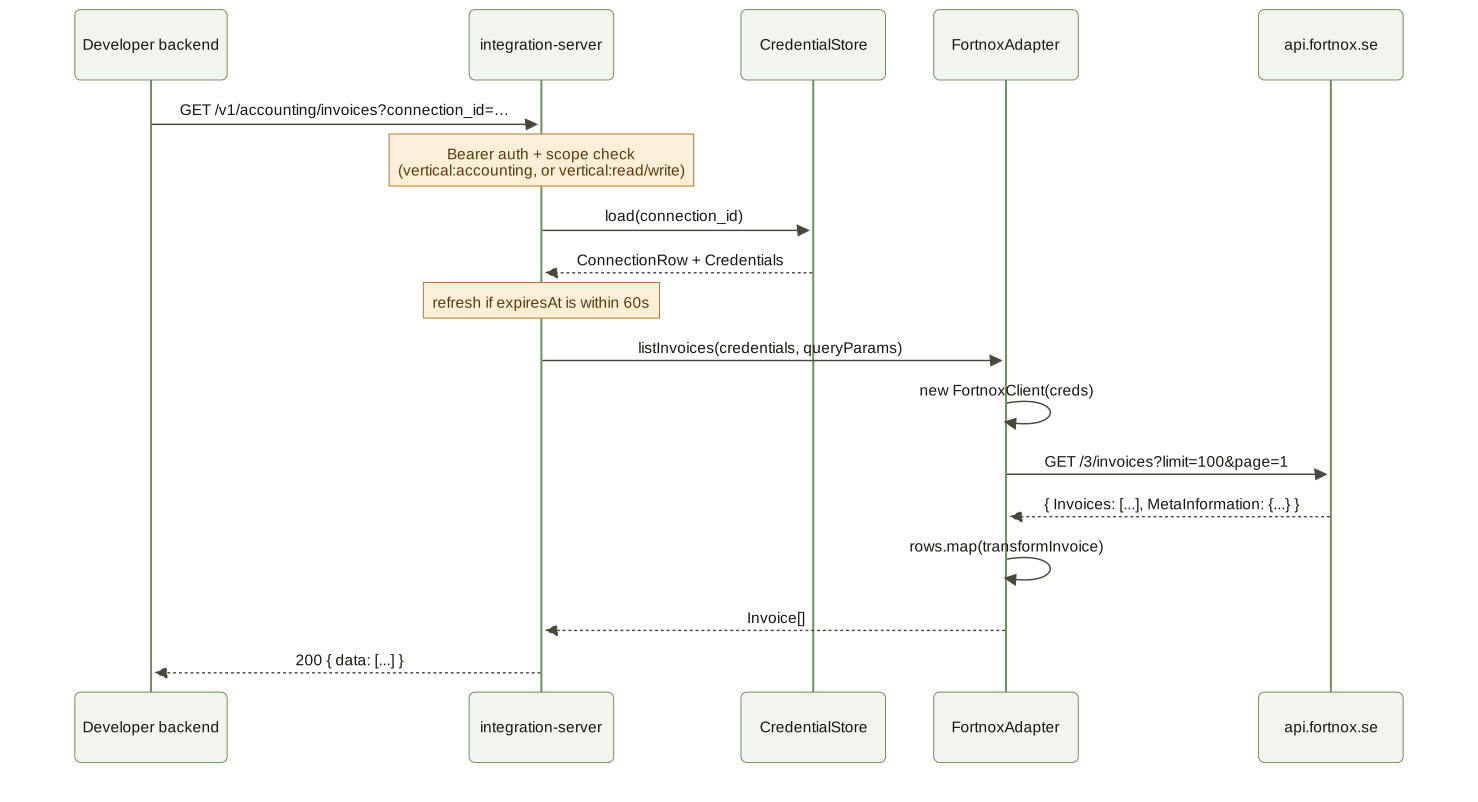
Five participants, each owning exactly one thing:
| Layer | Owns |
|---|---|
Server (apps/integration-server/src/server.ts) |
Bearer-key auth, scope check, rate limit, vertical router dispatch |
CredentialStore (@opensteward/shared) |
Decrypted credentials, on-demand refresh under a per-connection lock (refreshWithRotationGuard), and the recorded refresh outcome |
FortnoxAdapter.listInvoices |
Build the upstream call shape; consume credentials |
FortnoxClient |
HTTP transport + 429 retry |
transformInvoice |
Raw → canonical |
No layer reaches across. The adapter never touches the database; the store never touches HTTP; the transform never touches credentials. That separation is what makes 1,548 adapters reviewable — and it’s the lens to keep in mind for the rest of this page. The sections below walk each file in the order it would fire across a connection’s lifetime.
constants.ts — what’s pinned
Section titled “constants.ts — what’s pinned”export const FORTNOX_AUTH_URL = 'https://apps.fortnox.se/oauth-v1/auth'export const FORTNOX_TOKEN_URL = 'https://apps.fortnox.se/oauth-v1/token'export const FORTNOX_API_BASE = 'https://api.fortnox.se/3/'
export const RATE_LIMIT_RPM = 300 // documented upstream limitexport const MAX_PAGE_SIZE = 500 // Fortnox-imposedexport const DEFAULT_PAGE_SIZE = 100 // what we send when caller doesn't askAdapter constants are kept in one tiny file rather than scattered through the code. New adapters should mirror this — base URL, OAuth endpoints, any rate-limit / page-size numbers documented by the upstream. No magic strings elsewhere in the adapter.
auth.ts — the OAuth dance
Section titled “auth.ts — the OAuth dance”Three exported functions, in the order they fire across a connection’s lifetime:
buildAuthUrl(clientId, redirectUri, scopes, state)
Section titled “buildAuthUrl(clientId, redirectUri, scopes, state)”Builds the authorize URL the customer is redirected to. Standard RFC 6749 § 4.1.1 query string — response_type=code, client_id, redirect_uri, scope, state, plus Fortnox’s required access_type=offline (so the upstream returns a refresh token, not just an access token).
The adapter doesn’t decide when this URL is built — that’s the control plane’s job. The control plane calls adapter.getAuthUrl(state) when a Connect Link is opened or /auth/{vertical}/{platform}/connect is hit.
exchangeCode(code, clientId, clientSecret, redirectUri)
Section titled “exchangeCode(code, clientId, clientSecret, redirectUri)”Trades the authorization code (returned to the redirect URI) for tokens. POSTs grant_type=authorization_code to the token endpoint using HTTP Basic auth (Authorization: Basic <base64(clientId:clientSecret)>).
Two small helpers are in scope here:
function basicAuth(clientId: string, clientSecret: string): string {  return Buffer.from(`${clientId}:${clientSecret}`).toString('base64')}
function parseTokenResponse(data: Record<string, unknown>): Credentials {  return {    accessToken: data['access_token'] as string,    refreshToken: data['refresh_token'] as string | undefined,    expiresAt: new Date(Date.now() + (data['expires_in'] as number) * 1000),    scope: data['scope'] as string | undefined,  }}
Shared versions of these helpers live in @opensteward/shared; use those in new adapters. Adapters with bespoke fields (Salesforce instance_url, Sage firmId) keep their custom variants.
refreshAccessToken(refreshToken, clientId, clientSecret)
Section titled “refreshAccessToken(refreshToken, clientId, clientSecret)”Same shape, grant_type=refresh_token. One important detail at the bottom:
const creds = parseTokenResponse(data)if (!creds.refreshToken) creds.refreshToken = refreshToken // preserve old token if upstream omits itreturn credsSome providers (Fortnox among them) only return refresh_token on the first exchange. If we naively wrote whatever the refresh response gave us, we’d lose the refresh token on the second hop and brick the connection. The adapter is responsible for this preservation — the control plane does not know which providers rotate vs. preserve refresh tokens.
client.ts — the HTTP wrapper
Section titled “client.ts — the HTTP wrapper”A tiny class wrapping axios.create():
export class FortnoxClient {  private http: AxiosInstance
  constructor(credentials: Credentials) {    this.http = axios.create({      baseURL: FORTNOX_API_BASE,      headers: {        Authorization: `Bearer ${credentials.accessToken}`,        'Content-Type': 'application/json',        Accept: 'application/json',      },    })  }
  async get<T>(path: string, params?: Record<string, unknown>): Promise<T> {    return withRetry(async () => {      const { data } = await this.http.get<T>(path, { params })      return data    })  }
  // post / put / delete have the same shape}
Two things to notice:
- Per-call instantiation. Every adapter resource method does
const client = new FortnoxClient(credentials). The client is cheap to construct and not cached — each/v1/*request brings its own credentials, so the client is too. withRetry. Retries 429 with exponential backoff. It lives in@opensteward/shared; new adapters shouldimport { withRetry } from '@opensteward/shared'rather than redefine it locally.
There is no rate-limit budget here — withRetry is reactive (back off when 429 arrives), not proactive (queue requests against a known limit). That’s a deliberate choice: per-adapter accurate budgets are surprisingly hard to maintain (limits drift, vary by plan, vary by endpoint), and an “honest 429” path is more resilient than a stale budget.
index.ts — the adapter class
Section titled “index.ts — the adapter class”This is the public surface. The control plane only ever sees the methods on AccountingAdapter; everything in auth.ts / client.ts / transform/ exists to support these methods.
Constructor + config
Section titled “Constructor + config”interface FortnoxAdapterConfig { clientId: string clientSecret: string redirectUri: string scopes: string[]}
export class FortnoxAdapter implements AccountingAdapter { readonly platform = 'fortnox' readonly version = '0.1.0'
constructor(config: FortnoxAdapterConfig) { this.clientId = config.clientId this.clientSecret = config.clientSecret this.redirectUri = config.redirectUri this.scopes = config.scopes } ...}The config object is what adapter/factories.ts passes when the runtime decides to wire Fortnox up. The platform and version fields are part of the contract — they show up in audit logs and outbound webhook events.
Auth wrappers
Section titled “Auth wrappers”Three thin methods delegate to auth.ts:
getAuthUrl(state, overrideScopes?) {  return buildAuthUrl(this.clientId, this.redirectUri, overrideScopes ?? this.scopes, state)}
async exchangeCode(code, redirectUri) {  return exchangeCode(code, this.clientId, this.clientSecret, redirectUri)}
async refreshCredentials(credentials) {  if (!credentials.refreshToken) throw new Error('No refresh token available')  return refreshAccessToken(credentials.refreshToken, this.clientId, this.clientSecret)}
getAuthUrl accepts an optional overrideScopes argument — that’s how the Connect Link “per-link scope override” feature works (admin picks a scope group at mint time, the override flows into the auth URL).
One resource method in detail — listInvoices
Section titled “One resource method in detail — listInvoices”async listInvoices(credentials: Credentials, params: QueryParams): Promise<Invoice[]> { const client = new FortnoxClient(credentials) const res = await client.get<{ Invoices: FortnoxInvoice[]; MetaInformation: MetaInfo }>( 'invoices', this.paginationParams(params), ) return (res.Invoices ?? []).map(transformInvoice)}Five steps, every list method follows the same shape:
- Build a client with the request’s credentials.
- GET the upstream endpoint, passing through pagination params.
- Type the response with the raw platform shape (
FortnoxInvoice, not the canonicalInvoice). - Map each raw row through the transform — converts to canonical shape, preserves
metadata. - Return the canonical array. The router serialises it to JSON.
The transform is where adapter-specific knowledge gets normalised away. Above that line everything is canonical; below it everything is platform-specific.
The pagination shim
Section titled “The pagination shim”private paginationParams(params: QueryParams): Record<string, unknown> { return { limit: Math.min(params.limit ?? DEFAULT_PAGE_SIZE, MAX_PAGE_SIZE), page: params.page ?? 1, ...(params.updatedAfter && { lastmodified: params.updatedAfter.toISOString().split('T')[0], }), }}Canonical QueryParams uses limit / page / updatedAfter. Fortnox uses limit / page / lastmodified (YYYY-MM-DD). The shim translates between them, clamping limit to the upstream max. Other adapters do the same thing with their own field names — cursor, page_info, nextToken, etc.
A namespacing trick worth noticing
Section titled “A namespacing trick worth noticing”listContacts joins two upstream endpoints — Fortnox has separate /customers and /suppliers and we expose them as one canonical contact list. The transform tags each row, and getContact(id) reads a prefix to know which one to call:
async getContact(credentials: Credentials, id: string): Promise<Contact> { const client = new FortnoxClient(credentials) if (id.startsWith('cust_')) { const num = id.slice(5) const res = await client.get<{ Customer: FortnoxCustomer }>(`customers/${num}`) return transformCustomer(res.Customer) } if (id.startsWith('supp_')) { ... } throw new Error(`Invalid contact id format: ${id}. Expected cust_<n> or supp_<n>`)}A handful of adapters need this <type>_<n> id-namespacing trick when the upstream splits one canonical resource into two endpoints. The naming convention (cust_ / supp_) is per-adapter — what matters is that list…() and get…(id) agree.
transform/invoice.ts — the canonical mapping
Section titled “transform/invoice.ts — the canonical mapping”The transform is the soul of the adapter. Every line here is a decision about how Fortnox’s shape becomes the canonical shape.
Typed raw shape
Section titled “Typed raw shape”export interface FortnoxInvoice { DocumentNumber: string CustomerNumber: string InvoiceDate: string DueDate: string Total: number Balance: number Currency: string Booked: boolean Cancelled: boolean InvoiceRows: FortnoxInvoiceRow[] [key: string]: unknown // catch-all so unknown fields don't trip TypeScript}The raw shape is narrowed, not exhaustive — we type the fields we care about, then add [key: string]: unknown so unknown fields survive into metadata without TypeScript complaints. New adapters should do the same: type the fields you transform, let the rest live in the index signature.
Status mapping
Section titled “Status mapping”function mapStatus(inv: FortnoxInvoice): InvoiceStatus { if (inv.Cancelled) return 'VOIDED' if (inv.Booked && inv.Balance === 0) return 'PAID' if (inv.Booked && inv.Balance > 0 && inv.Balance < inv.Total) return 'PARTIALLY_PAID' if (inv.Booked) return 'AUTHORIZED' return 'DRAFT'}Fortnox doesn’t have an explicit status field — it’s derived from the booleans Cancelled / Booked and the Balance vs Total relationship. The canonical InvoiceStatus is one of DRAFT | AUTHORIZED | PAID | PARTIALLY_PAID | VOIDED. This derivation is the least obvious part of the mapping (“why is this booked invoice showing AUTHORIZED?”) — putting it in a named mapStatus function keeps the decision tree readable.
Line items
Section titled “Line items”function mapLineitem(row: FortnoxInvoiceRow): Lineitem { return { id: String(row.RowId), accountId: row.AccountNumber || undefined, itemId: row.ArticleNumber || undefined, unitAmount: row.Price, unitQuantity: row.OrderedQuantity, totalAmount: row.Total, taxAmount: row.VAT, discountAmount: row.Discount || undefined, }}Two patterns to absorb:
X || undefinedinstead ofXfor strings. Fortnox returns""for empty strings; the canonical schema wantsundefined. The|| undefinedcollapses both into the same shape.String(row.RowId). All canonical ids are strings — even when the upstream gives an integer. Cast at the boundary; never let a number-typed id leak into the canonical surface.
The transform itself
Section titled “The transform itself”export function transformInvoice(raw: FortnoxInvoice): Invoice { return { id: raw.DocumentNumber, type: 'INVOICE', status: mapStatus(raw), invoiceNumber: raw.DocumentNumber, contactId: prefixedId('cust', raw.CustomerNumber), currency: raw.Currency || undefined, totalAmount: toMinorUnits(raw.Total), taxAmount: toMinorUnits(raw.TotalVAT), balanceAmount: toMinorUnits(raw.Balance), lineitems: raw.InvoiceRows ? raw.InvoiceRows.map(mapLineitem) : null, postedAt: raw.InvoiceDate ? new Date(raw.InvoiceDate) : undefined, metadata: raw as Record<string, unknown>, }}Three lines there are load-bearing, and each was once written the obvious way and shipped a silent bug:
prefixedId('cust', …), not the bare number. Fortnox merges/customersand/suppliersinto one canonicalContactlist, so ids are prefixed to keep customer #1 apart from supplier #1 — and every FK pointing at a contact must carry the same prefix or the join resolves to nothing.untransform*strips it again withunprefixedId, because the platform has never heard ofcust_. Guarded bycheck:contact-fk-prefix.toMinorUnits(…), not the raw decimal. CanonicalAmountisz.number().int()in minor units; Fortnox speaks decimal SEK. Passing the value through stores it 100x under contract.raw.InvoiceRows ? … : null, not?? []. Fortnox’s list endpoint omitsInvoiceRowsentirely.[]is a positive assertion that the document has no line items; emitting it for “not reported” is a false statement a consumer cannot detect. Returnnullwhen the key is absent and[]only when the source really sent an empty collection. The rule is stated in full onnullishinpackages/shared/src/schemas/zod-helpers.tsand guarded bycheck:collection-null-policy.
The non-negotiable rule: metadata: raw as Record<string, unknown>. Every canonical object preserves the raw upstream object verbatim. Consumers that need a field the canonical schema doesn’t cover read it from metadata.<field>. The metadata test (expect(transformInvoice(raw).metadata).toBe(raw)) verifies the same reference — not a copy, not a filtered subset.
untransformInvoice — the inverse
Section titled “untransformInvoice — the inverse”export function untransformInvoice(invoice: Partial<Invoice>): Record<string, unknown> { return { CustomerNumber: invoice.contactId, Currency: invoice.currency, InvoiceDate: invoice.postedAt?.toISOString().split('T')[0], DueDate: invoice.dueAt?.toISOString().split('T')[0], ExternalInvoiceReference1: invoice.reference, InvoiceRows: invoice.lineitems?.map((li) => ({ ArticleNumber: li.itemId, Description: li.itemDescription, Price: li.unitAmount, OrderedQuantity: li.unitQuantity, AccountNumber: li.accountId, })), }}Adapters that support createX / updateX need an untransformX going the other direction. It accepts Partial<Canonical> — operators can update three fields without the canonical shape getting in their way. The function returns the upstream’s expected body shape.
webhook.ts — inbound webhooks
Section titled “webhook.ts — inbound webhooks”Fortnox uses a bearer-token style verification, not HMAC. Each platform pins its own scheme; the canonical WebhookHandler interface is the same shape regardless of how verification is done:
export const fortnoxWebhook: WebhookHandler = {  verifyWebhook(_payload, headers, secret) {    const authHeader = headers['authorization'] ?? ''    const token = authHeader.startsWith('Bearer ') ? authHeader.slice(7) : authHeader    if (!token) return false    const a = Buffer.from(token)    const b = Buffer.from(secret)    if (a.length !== b.length) return false    return timingSafeEqual(a, b)   // constant-time compare!  },
  parseWebhookEvents(payload) { ... },}
The hard rule for verifyWebhook: constant-time comparison (crypto.timingSafeEqual or one of the shared verifyHmacSha256 / verifyStripeStyleSignature / verifyGithubStyleSignature helpers in @opensteward/shared). Never === on a secret — it leaks bytes on a timing side-channel.
The verification returns boolean, and the caller is integration-server’s unified webhooks router (POST /webhooks/{vertical}/{platform}, packages/shared/src/control-plane/webhooks-router.ts) — not webhook-gateway, which only forwards the body. That router fails closed: false from every candidate secret means 401 INVALID_WEBHOOK_SIGNATURE, no events parsed, nothing emitted. It tries each connection’s own webhook secret before the static per-platform one, so the secret that verifies is also what identifies the owning connection.
Event mapping
Section titled “Event mapping”function mapResourceType(entityType: string): WebhookResourceType { const map: Record<string, WebhookResourceType> = { INVOICE: 'invoice', SUPPLIER_INVOICE: 'bill', CUSTOMER: 'contact', SUPPLIER: 'contact', ACCOUNT: 'account', VOUCHER: 'journal', ARTICLE: 'unknown', ORDER: 'order', OFFER: 'salesorder', PURCHASE_ORDER: 'purchaseorder', } return map[entityType.toUpperCase()] ?? 'unknown'}
function mapAction(eventType: string): WebhookAction { const ev = eventType.toUpperCase() if (ev.includes('CREAT')) return 'created' if (ev.includes('UPDAT')) return 'updated' if (ev.includes('DELET') || ev.includes('REMOV')) return 'deleted' return 'unknown'}The two-table approach (resource map + action map) is the standard. Unknown values fall through to 'unknown' — that becomes a canonical event with resourceType: 'unknown' rather than a thrown error. Webhook handlers must not throw.
Single event vs batch
Section titled “Single event vs batch”Fortnox sends either a single top-level event or a batch in events[]. The handler normalises both shapes into the same array, so downstream code doesn’t branch:
const rawEvents: FortnoxWebhookEvent[] = Array.isArray(body.events) && body.events.length > 0 ? body.events : body.entityType ? [{ eventId: '', entityType: body.entityType, eventType: ..., entityId: ... }] : []Most upstreams have one of these two shapes. Whichever yours has, normalise to one array before mapping.
When you scaffold a new adapter
Section titled “When you scaffold a new adapter”Copy fortnox/ (or the reference adapter for your vertical — nutshell/ for CRM, shopify/ for ecommerce, easypost/ for logistics, stripe/ for payments, docusign/ for docsign, asana/ for projects, zendesk/ for customer-support, cin7-core/ for inventory) and rename. pnpm run scaffold:adapter does the copy-and-rename for you. Then change exactly six things:
constants.ts— pin the new platform’s URLs and limits.auth.ts— adjust the OAuth body shape if the upstream is non-standard (e.g. noaccess_type=offline).client.ts— usually identical; change only the auth header style if the upstream uses something other thanAuthorization: Bearer.index.ts— replaceFortnoxAdapter/FortnoxClient/FortnoxXreferences, and implement whichever resource methods the upstream supports. Unimplemented methods auto-return 501.transform/*.ts— write the raw shape + status mapping + field mapping for each resource you implement.webhook.ts— if the platform signs with HMAC-SHA256, importverifyHmacSha256from@opensteward/shared. Otherwise write the verifier the way Fortnox does (constant-time bearer compare).
Then add one entry to adapter/factories.ts and one row to platforms/metadata.ts — check:adapter-parity fails the build if metadata gains a slug with no factory, and warns on the reverse. Run pnpm run docs:all to refresh every generated artifact (the platforms catalog, the OpenAPI spec, Postman, SDK and CLI); check:docs fails the build if any of them is stale.
Then run pnpm check:paging-contract --only=<vertical>/<slug>. The clone inherits its reference adapter’s list methods, and five of the nine reference adapters still carry baselined paging failures: easypost 5, stripe 1, docusign 5, asana 6 and zendesk 7 (for example, a list that sends the same request for page 2 as for page 1). The baseline is keyed by slug, so under the new slug those failures count as new and fail CI on the first run. Make the new adapter page the way its vendor’s API documents, sending the caller’s params.limit as the page size and moving the position with params.page, until the gate is clean. Banking the verdicts with --update is the last resort, not the default.
When one upstream page is not one caller page — pageByRows and pageLocally
Section titled “When one upstream page is not one caller page — pageByRows and pageLocally”A caller’s page N is rows [(N−1)×limit, N×limit). Some upstreams cannot serve that directly:
| The upstream… | Example | Use |
|---|---|---|
| returns the whole collection in one response | Salesforce’s single synthesised pipeline | pageLocally(all, params) |
| pages in batches that are not the caller’s size | Salesforce SOQL: 200–2,000 rows per batch, whatever limit is |
pageByRows |
| yields rows flattened out of pages of a parent | Shopify fulfillments out of pages of orders, variants out of products | pageByRows |
| streams several endpoints as one list | Salesforce Tasks then Events; Shopify custom then smart collections | pageByRows with a composite cursor |
Returning one upstream page as the caller’s page is the bug both helpers exist for. The router truncates a page longer than limit and the next page starts after the rows it dropped (Salesforce at limit=25 served 25 of every 200 rows). A page that is short but not the end ends a sync early, unless hasMore says otherwise.
pageLocally(all, params) slices the collection and reports the exact totalCount and hasMore; params with no usable limit (absent, or not a finite number ≥ 1: a direct call, never the router’s) get every row, since every row is already in hand. pageByRows reads the same params differently on purpose, because it would have to walk the whole upstream to serve everything: a missing limit is its defaultLimit (100 unless set), and an unusable one throws a RangeError. all must be every row matching the query, never one sized page of a paginated endpoint: the total is reported as fact, the cache marks the collection complete on it, and the gate passes the method on the report.
pageByRows(key, params, fetch, options) walks the upstream chain, where fetch(cursor) returns { items, next } for one upstream page and fetch(undefined) returns the first. A cursor must be a replayable position: fetching it again returns that page again. It serves exactly the caller’s rows, reports hasMore exactly (it peeks one upstream page when a caller page ends on a boundary), and continues the next caller page from the upstream page it already holds, so a walk costs one request per upstream page. Identical calls in flight (a client retrying a slow page 1) share one walk.
Build key with cursorPagerKey(connectionScope(account, credentials), collection, upstreamQuery):
- The scope must identify the connection, not only the account. The row pager keeps the ROWS it fetched, and serves the next page from them without a request. Keyed by a Salesforce org or a Shopify shop, a second user’s page came out of the first user’s batch, past their own sharing rules or scopes.
connectionScopeadds a fingerprint of the connection’s refresh token (else its access token) to the account; the token itself never enters the key. - It must include every filter and the upstream page size. Leave the caller’s
limitout unless the upstream page is sized from it, since row positions do not depend on it. - Two lists flattened from the same parent pages need different keys.
Choose maxUpstreamPages for sparse rows: filling one page of rare refunds can walk many pages of orders. A page that runs out of budget while only peeking past a complete page is returned with hasMore: true; one that runs out short throws, and a retry resumes from where it stopped (page 1 too, within a minute of the failure). A fetch that throws forgets its cursor, so a retry starts from the one before; where the platform names an expired chain (Salesforce’s INVALID_QUERY_LOCATOR), pass restartOn to walk again from the first page in the same call. A caller holding an explicit upstream cursor is at a position, not a row offset, so keep that path as one upstream page. crm/adapters/salesforce and ecommerce/adapters/shopify are the worked examples.
Both helpers also report pagedLocally. Two caller pages inside one upstream page send the same request, which check:paging-contract would otherwise read as page-ignored or fixed-size; with the report on page 1 and page 2 (and neither call throwing) it passes them as local-page. It still fails a page 1 that skips rows or over-asks, a position that moves between page 1 and page 2 by more than the caller’s limit (or, beside a size that follows the limit, by neither 1 nor the limit), and a page 2 that repeats a request whose size follows the limit (pageLocally over one page of ?limit=<limit>). Requests that pass on their own keep their own verdict, local-page is not counted as coverage, and it is never a declared-max violation. A hand-rolled window may report pagedLocally: true through reportUpstreamPage too, but only when it serves exactly the caller’s rows and its own tests prove every row is served once: the gate takes the claim on trust, so list the file in LOCAL_PAGE_REPORTERS in scripts/check-paging-contract.ts with that test (a full sweep fails on an unlisted reporter). A window that pages at less than params.limit (a direct call past its maximum, which the router and the sync never make) reports that size as pageSize too, so the page is judged at the size it was cut at. Epos Now’s V4 window (fixed 200-row pages that take no size) and Lumin Sign’s templates (an upstream size snapped to 10/25/50) are the worked examples.
Tests come next — see CONTRIBUTING.md § 6 for the test-factory pattern (every transform gets a test file with a make<Name>() factory, a happy-path assertion, a metadata passthrough assertion, and a missing-optional-fields assertion).
Common variations across adapters
Section titled “Common variations across adapters”Things that change per adapter (so you know what to look for when you scaffold from a different reference):
| Concern | Fortnox does | Common alternatives |
|---|---|---|
| Auth header | Authorization: Bearer <token> |
X-Shopify-Access-Token, X-Api-Key, custom session cookies |
| Pagination | limit + page (page numbers) |
cursor / page_info / nextToken (opaque cursor strings) |
| Auth flow | OAuth2 authorization-code with refresh | OAuth2 client-credentials, API-key only, basic auth, signed JWT |
| Webhook verification | Bearer token compare | HMAC-SHA256 hex / base64, Stripe-style t=…,v1=…, GitHub-style sha256=… |
| Id format | Upstream string id verbatim | <type>_<n> namespacing when one canonical resource spans multiple endpoints |
| Refresh-token rotation | Upstream omits → adapter preserves the old one | Upstream rotates → adapter writes whatever it received |
When you scaffold, the file layout is identical to Fortnox; the contents of each file diverge along these axes. Fortnox is a deliberately simple choice for a first read because it sits in the middle of each axis (standard OAuth, page-number pagination, bearer webhook auth) — no exotic upstream conventions to explain.
See also
Section titled “See also”CONTRIBUTING.md— the canonical reference for what an adapter must doauth-and-tenancy.md— whatcredentials,tenant_id, andowner_tenant_idmeanruntime-flows.md— the request / OAuth / webhook sequence diagrams in chart formvertical-internals.md— how a single vertical’s plugin assembles its router + middlewareadapter-lifecycle.md— the enable / disable / configure state machine
opensteward.dev ·Plans and free license ·Terms ·Privacy ·support@opensteward.dev
© 2026 Falco Consulting AB. Built from open-steward/opensteward@a3961d8. This site sets no cookies, runs no analytics and loads nothing from other sites, except platform logos from Brandfetch on the Platforms page.